— Barack Obama, 2012, on the disarming of Ukraine
Saturday, 26 February 2022
Wrong.
“Missile by missile, warhead by warhead, shell by shell, we’re putting a bygone era behind us. Inspired by Sam Nunn and Dick Lugar, we’re moving closer to the future we seek. A future where these weapons never threaten our children again. A future where we know the security and peace of a world without nuclear weapons.”

Saturday, 29 January 2022
When all you have is a hammer....
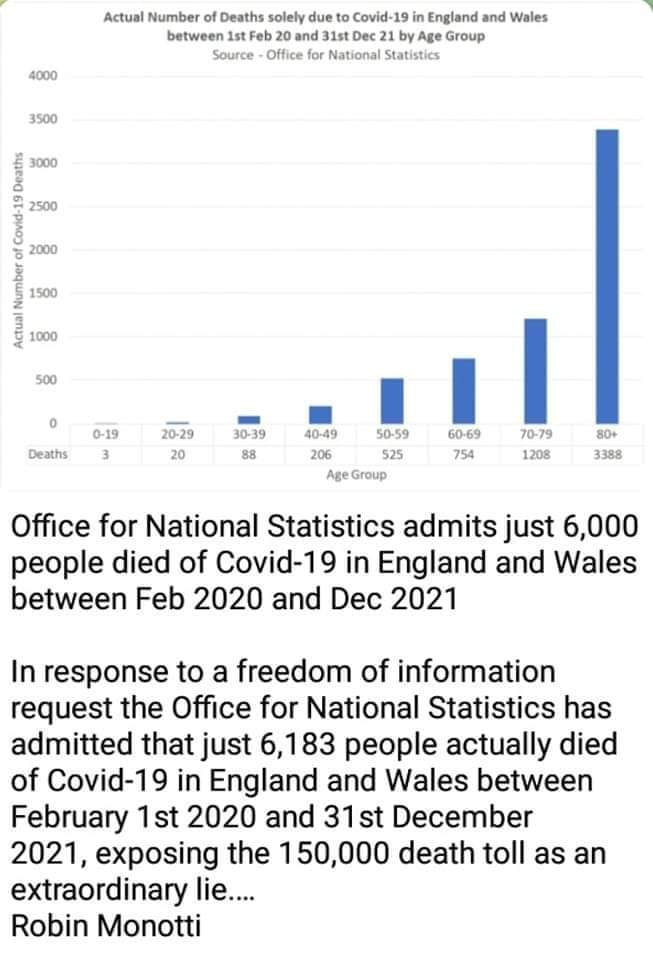
Excitable conspiracy theorists are triumphantly distributing this "revelation" that only 6000 people in the UK have EVER died of Covid-19. What's particularly odd is that they simultaneously believe that there's been a massive cover-up by the Government and that they've uncovered the secret by simply asking the Government for the information. I'll happily take on all comers in the Ridiculing Government Incompetence Games, but come on, seriously.
Because of course there is no cover-up or revelation here. The controversy is based on the obvious bollocks that "died of" and "died solely of" are the same thing, which they aren't remotely. The premise here is that having two things on a death certificate means that neither of those things is fatal. When of course their fatality is the reason they're on a death certificate.
The logic is puzzlingly unidirectional, too.
- "This person has covid and condition X on their death certificate; therefore condition X killed them and covid didn't."
- "This person has covid and condition X on their death certificate; therefore covid killed them and condition X didn't."
These two arguments are logically identical, yet the conspiracy theorists are only making one of them and regard the other as crazy.
Comorbidities are a thing. Two examples.
Firstly, diabetes is a comorbidity of covid. The conspiracy theorists claim that every diabetic person who died of covid in fact died of diabetes and merely happened to have completely non-fatal covid at the time. But diabetes doesn't kill you in weeks; it kills you in decades. When a forty-year-old with diabetes dies of covid, yes, it's technically true that they were going to die of diabetes "anyway" — in twenty-five to thirty-five years time. When some other disease accelerates that timeline to a month, the conventional way to describe the process is "killing".
Secondly, HIV. HIV screws up your immune system, causing you to eventually die of whatever ailment happens to come along. People with AIDS die of tuberculosis or cancer or meningitis or some other opportunistic infection. No-one has ever died of only HIV. By the exact same reasoning the conspiracy theorists are applying to the covid stats, the all-time worldwide fatality rate of HIV is zero.
Thursday, 13 January 2022
Prince Andrew's defence in full.
"I went to lots of parties at the houses of my close friend the convicted paedophile pimp. While I was there, there were always young borderline-underage girls hanging around, partying with me and the other unattractive rich old friends of my close friend the convicted paedophile pimp. None of these girls ever had any family or parents around, but I thought nothing of it. I never found it suspicious that these borderline-underage girls might be partying not with other young people of their own age but with me and the other unattractive rich old friends of my close friend the convicted paedophile pimp. I never wondered what their parents, whom nobody ever mentioned or seemed to know, thought about it. I enjoyed partying with at least one of these borderline-underage girls myself.
"BUT I DIDN'T FUCK HER."
Monday, 10 January 2022
There's more to conspiracy theories than just theories about conspiracies.
Leonid Brezhnev set up a department within the KGB tasked with finding out who was really running Capitalism.
He was, of course, perfectly well aware of the "official" (a.k.a. accurate) explanation of free markets: that each individual shopkeeper freely chooses to set the price of each of their products at whatever they want; and that they adjust those prices based on their personal judgement of the balance between too high to sell any and too low to be worth selling. He just didn't believe it. Immersed in an environment of centralised control by diktat, he couldn't bring himself to believe that anything could work effectively without it. I like to imagine those KGB officers, beavering away, chasing down leads, convincing themselves that this time they're genuinely on the trail of that elusive man who secretly contacts EVERY SHOPKEEPER IN THE WORLD and tells them all their prices. I truly hope that they found the occasional shopkeeper willing to break the code of silence and spill the beans. Fun times.
Brezhnev was a conspiracy theorist.
Thing is, Brezhnev also believed in lots of real conspiracies that really were happening. He'd have been an idiot not to, and an idiot with a short life expectancy at that. It was the Cold War, probably humanity's peak of weaponised conspiracy. Brezhnev was the Russian Premier and dictator of the USSR. Approximately half the conspiracies he believed in, he was nominally in charge of. Would it have been irrational of him to suspect that the CIA might be trying to undermine his grip on power? Of course not. They were.
For Brezhnev, believing in conspiracies was not, mostly, conspiracy theorism; it was perfectly sensible theories about conspiracies. And yet, on top of all that common sense and rational deduction, he was also a conspiracy theorist.
So what's the difference?
The thing about conspiracy theorists is not that they believe in conspiracies at all, but that they believe in conspiracies first and foremost and no matter what. When the evidence points towards conspiracy, they believe in the conspiracy. When the evidence points towards an accident or a coincidence or something that just happened, they still believe in the conspiracy. When there is proof that the conspiracy didn't happen, they conclude that the proof must have been faked by the conspirators as part of a cover-up, and therefore that all evidence against a conspiracy is in fact just yet more evidence of the conspiracy.
The second belief conspiracy theorists cling to follows necessarily from the first: that there is no effective limit to the number or type of people who can keep a secret, or for how long. The dogma of constant omnipresent conspiracy that somehow remains secret cannot survive without insane numbers of people, often each other's enemies, all taking part in the cover-up.
That was the key difference Brezhnev should have noticed. He knew that the way the KGB kept their conspiracies secret was by telling as few people as possible as little as possible, and, when necessary, killing people to reduce the number who knew. The sheer number of people choosing for themselves what to charge for their goods and services — basically, all of us — shouldn't have passed the smell test. And even those Westerners who opposed Capitalism and supported the USSR were setting their own prices. Wouldn't one of them have spilt the beans? Just how devilishly cunning was this conspiracy?
Look at Flat-Earthers. Their fundamental belief is a bit odd, considering that you can literally see the Earth's curvature. But it's nowhere near their craziest idea. They believe that all the world's governments know that the Earth is really flat and have been working together for decades to suppress the truth. That's governments working together and always succeeding and never having any leaks. They believe that, during the Cold War, the Americans and Russians collaborated in this conspiracy. During that era of defections and triple-agents, everyone stayed on-message with their mortal enemies. During the Cuban Missile Crisis, the Russians and Americans were still, on this one issue, working together, staunch allies in the fight against people discovering that the Earth isn't round. Have these eejits ever met a human?
And where's the motive? They don't want us to know that the Earth is flat, because then we might... WHAT? What would we do with this knowledge? And how would it harm our Lords & Masters?
Back at the start of The Cursed Pandemic, we now know that various institutions, including the World Health Organization, the British Government, and the American Government, all claimed that masks were completely useless against SARS-CoV-2 while they in fact believed that masks were useful. (Later arguments about the possible inefficacy of masks are immaterial here; the point is that the people claiming they were useless believed them to be useful at the time.) They did this, as they have since admitted, because they were worried about supplies of masks for medical staff, and they wanted to discourage the public from buying them so that there would be plenty available for hospitals. Some of us noticed the lie at the time. We weren't conspiracy theorists; we were merely people with a theory about a conspiracy. The conspiracy was not unlikely: it involved the careful coordination of public communication by organizations that do usually carefully coordinate their public communications. It did not require us to believe that thousands of people all kept on-message, since there was widespread disagreement and argument. They didn't manage to keep it all secret for decades; they barely made it a few weeks. There were various plausible hypothetical motives, one of which turned out to be true. And there was actual evidence that masks are useful. To believe in this conspiracy, at no point did anyone have to elevate their dogmatic belief in conspiracy above a reasonable assessment of actual evidence.
There have been so many ridiculous claims made over the last two years, I could pick dozens of examples. I'll go with one from the anti-vaxxers: that mRNA vaccines killed every single animal they were injected into during animal trials, and the researchers destroyed all records of those results so that they could proceed to mass human vaccination. I have spoken to people online who genuinely believe this. First of all, it has to be said: what a stroke of luck! These vaccines, developed by people who are determined to commit genocide, killed every single non-human mammal they were ever given to, and yet have only had fatal side-effects in a tiny proportion of humans. What are the chances that humanity's would-be murderers would create the one toxin that kills every animal except humans? They must be kicking themselves.
And imagine the conversation that needs to have happened:
Now, that's a conspiracy theory. Because the only way you can possibly believe it is if you start with an iron-clad belief in the secret machinations of nefarious cabals, and ignore every ounce of evidence and common sense and basic knowledge of human nature that says — nay, screams — that it's a load of old bollocks.
And all of that is why this argument holds no water:
He was, of course, perfectly well aware of the "official" (a.k.a. accurate) explanation of free markets: that each individual shopkeeper freely chooses to set the price of each of their products at whatever they want; and that they adjust those prices based on their personal judgement of the balance between too high to sell any and too low to be worth selling. He just didn't believe it. Immersed in an environment of centralised control by diktat, he couldn't bring himself to believe that anything could work effectively without it. I like to imagine those KGB officers, beavering away, chasing down leads, convincing themselves that this time they're genuinely on the trail of that elusive man who secretly contacts EVERY SHOPKEEPER IN THE WORLD and tells them all their prices. I truly hope that they found the occasional shopkeeper willing to break the code of silence and spill the beans. Fun times.
Brezhnev was a conspiracy theorist.
Thing is, Brezhnev also believed in lots of real conspiracies that really were happening. He'd have been an idiot not to, and an idiot with a short life expectancy at that. It was the Cold War, probably humanity's peak of weaponised conspiracy. Brezhnev was the Russian Premier and dictator of the USSR. Approximately half the conspiracies he believed in, he was nominally in charge of. Would it have been irrational of him to suspect that the CIA might be trying to undermine his grip on power? Of course not. They were.
For Brezhnev, believing in conspiracies was not, mostly, conspiracy theorism; it was perfectly sensible theories about conspiracies. And yet, on top of all that common sense and rational deduction, he was also a conspiracy theorist.
So what's the difference?
The thing about conspiracy theorists is not that they believe in conspiracies at all, but that they believe in conspiracies first and foremost and no matter what. When the evidence points towards conspiracy, they believe in the conspiracy. When the evidence points towards an accident or a coincidence or something that just happened, they still believe in the conspiracy. When there is proof that the conspiracy didn't happen, they conclude that the proof must have been faked by the conspirators as part of a cover-up, and therefore that all evidence against a conspiracy is in fact just yet more evidence of the conspiracy.
The second belief conspiracy theorists cling to follows necessarily from the first: that there is no effective limit to the number or type of people who can keep a secret, or for how long. The dogma of constant omnipresent conspiracy that somehow remains secret cannot survive without insane numbers of people, often each other's enemies, all taking part in the cover-up.
That was the key difference Brezhnev should have noticed. He knew that the way the KGB kept their conspiracies secret was by telling as few people as possible as little as possible, and, when necessary, killing people to reduce the number who knew. The sheer number of people choosing for themselves what to charge for their goods and services — basically, all of us — shouldn't have passed the smell test. And even those Westerners who opposed Capitalism and supported the USSR were setting their own prices. Wouldn't one of them have spilt the beans? Just how devilishly cunning was this conspiracy?
Look at Flat-Earthers. Their fundamental belief is a bit odd, considering that you can literally see the Earth's curvature. But it's nowhere near their craziest idea. They believe that all the world's governments know that the Earth is really flat and have been working together for decades to suppress the truth. That's governments working together and always succeeding and never having any leaks. They believe that, during the Cold War, the Americans and Russians collaborated in this conspiracy. During that era of defections and triple-agents, everyone stayed on-message with their mortal enemies. During the Cuban Missile Crisis, the Russians and Americans were still, on this one issue, working together, staunch allies in the fight against people discovering that the Earth isn't round. Have these eejits ever met a human?
And where's the motive? They don't want us to know that the Earth is flat, because then we might... WHAT? What would we do with this knowledge? And how would it harm our Lords & Masters?
Back at the start of The Cursed Pandemic, we now know that various institutions, including the World Health Organization, the British Government, and the American Government, all claimed that masks were completely useless against SARS-CoV-2 while they in fact believed that masks were useful. (Later arguments about the possible inefficacy of masks are immaterial here; the point is that the people claiming they were useless believed them to be useful at the time.) They did this, as they have since admitted, because they were worried about supplies of masks for medical staff, and they wanted to discourage the public from buying them so that there would be plenty available for hospitals. Some of us noticed the lie at the time. We weren't conspiracy theorists; we were merely people with a theory about a conspiracy. The conspiracy was not unlikely: it involved the careful coordination of public communication by organizations that do usually carefully coordinate their public communications. It did not require us to believe that thousands of people all kept on-message, since there was widespread disagreement and argument. They didn't manage to keep it all secret for decades; they barely made it a few weeks. There were various plausible hypothetical motives, one of which turned out to be true. And there was actual evidence that masks are useful. To believe in this conspiracy, at no point did anyone have to elevate their dogmatic belief in conspiracy above a reasonable assessment of actual evidence.
There have been so many ridiculous claims made over the last two years, I could pick dozens of examples. I'll go with one from the anti-vaxxers: that mRNA vaccines killed every single animal they were injected into during animal trials, and the researchers destroyed all records of those results so that they could proceed to mass human vaccination. I have spoken to people online who genuinely believe this. First of all, it has to be said: what a stroke of luck! These vaccines, developed by people who are determined to commit genocide, killed every single non-human mammal they were ever given to, and yet have only had fatal side-effects in a tiny proportion of humans. What are the chances that humanity's would-be murderers would create the one toxin that kills every animal except humans? They must be kicking themselves.
And imagine the conversation that needs to have happened:
"We have the results of the animal trials. Our vaccine appears to be highly toxic. It killed every test subject. Every single one. Turns out it's not so much a vaccine as more of a venom."What I really can't get my head around is the recruitment process. I mean, how often do you meet someone who's really keen on genocide? How does a medical research lab go about recruiting scientists all of whom want to kill everyone on the planet? They can't exactly advertise their secret plot, so they'd get loads of applications from normal scientists who are going into the field of medical research because they have at least some intention of developing medicine. What do they ask them in the interview to try and sound out the misanthropic psychopaths? "Would you describe yourself as a people person?"?
"So, back to the drawing board, then?"
"No, we're going to hush up the results, go ahead with mass production, and inject it into every human on the planet."
"Er, why?"
"Mass genocide, of course. Why else would we be working in medical research?"
"Oh, OK, then."
Now, that's a conspiracy theory. Because the only way you can possibly believe it is if you start with an iron-clad belief in the secret machinations of nefarious cabals, and ignore every ounce of evidence and common sense and basic knowledge of human nature that says — nay, screams — that it's a load of old bollocks.
And all of that is why this argument holds no water:
"See? There really was a conspiracy! So we conspiracy theorists were right all along, and you need to start listening to us."Nope. You were unhinged. There was a conspiracy. And you're still unhinged.
Sunday, 8 November 2020
You are gaslighting yourself.
I am a mathematician. Not professionally, but mentally. I'm one of those people who had an affinity with numbers and logic from a very early age, which led eventually to a degree in maths and a career in IT. I understand that a lot of what seems bleeding obvious to people like me is opaque to many people. (This is not to be boastful: we all have our strengths and weaknesses, and Lord knows there's plenty I don't understand, like football and small talk and not making people want to punch me.) But I honestly did not appreciate until this week the extent to which obvious mathematical truths are complete mysteries to such a huge chunk of humanity.
Of course I'm talking about the cursed election. You may have seen these graphs:


Those graphs are evidence of something highly suspicious happening. Clearly and obviously, to anyone who understands numbers. That has nothing to do with what they're measuring. If they were graphs comparing the performance of two brands of dishwasher, they'd be suspicious. If they were exchange rates or share prices, the financial regulator would be demanding an explanation from the banks involved, and actively considering raiding those banks if such explanation was not forthcoming. The idea that those numbers are not suspicious is just preposterous. I shan't bother explicating why; one thing I've discovered this week is that those who can't already see it will determinedly continue not to. But the evidence honestly couldn't be much clearer. And yet the dominant claim, repeated all week throughout the world's media, is that there is "no evidence". Not that the evidence is, on balance, unconvincing, or that it can be explained, but that there simply is none. That so many millions of people are apparently willing to believe such a thing is the most damning indictment I have ever seen of the state of maths teaching.
Now, let's be clear here about what the word "evidence" actually means. It doesn't mean "proof". When a defendant is found not guilty, all the evidence against them doesn't cease to exist; it is still evidence against them, which has been weighed and found not damning. Even though they were not guilty, the evidence against them is the reason why it would have been remiss not to try them in court at all. Evidence is something that is worth looking into.
There are various scenarios that could explain graphs like that. "This is normal; nothing to see here" is not one of them — but that's the one we've been given, again and again, smugly and condescendingly, by people insisting that even being suspicious of numbers like that is a sign of knuckle-dragging stupidity.
But, utterly unsurprisingly, it turns out that the evidence was worth looking into. For instance, Antrim County, Michigan discovered that software had allocated 6000 votes to the wrong candidate. That's not a conspiracy theory; it's not a paranoid accusation by the losing party; it's a fact, verified and confirmed by the election officials. The numbers were evidence that something was wrong, so people investigated the numbers, and found that indeed something was wrong. That's how evidence is supposed to work. It may be that the software was hacked with the intent of fraud; it may also be a mere innocent error. But what it most certainly is not is nothing.
That software, incidentally, is in use in 47 counties. Since we now have proof that it malfunctioned to the tune of thousands of votes in one of those counties, that proof is in turn evidence that it may have done something similar in the other counties. That evidence should of course be investigated. It might turn out that it only miscounted in Antrim and worked correctly everywhere else. That's how evidence is supposed to work too. But claiming that it might have behaved the same way everywhere it was used (which is, after all, what such software is explicitly designed to do) is not crazy, is not sore losing, and is not an attempt at a fascist power-grab. It's an entirely reasonable suggestion. And refusing to investigate it would be insane.
I currently work in financial regulatory reporting. If I were to see numbers like that and not investigate them, I could go to prison. And I'd deserve it.
The graphs are far from the only evidence. Larry Correia set a load of it out here, along with a good explanation of what a red flag is in an audit and what it does and doesn't mean. I recommend reading it if you're interested in the US election.
But, believe it or not, I don't want to talk about the US election.
I've deliberately not mentioned Trump till now, because this isn't really about him — or shouldn't be. Trump will be gone in four years or a few weeks, and either one is the blink of an eye. (Note to teenagers: Yes it really is. Just wait.) Democracy, we should hope, will be with us somewhat longer.
Four years ago, in a context that was different yet ultimately the same, I wrote this:
Democracy works because enough people believe that they will get their way some of the time. Because of that, they are willing to accept the result when they don't get their way — they know their time will come soon enough. It is this general belief spread throughout the populace that has effectively stopped people resorting to violence. This is why not only actual propriety but the appearance of propriety in the electoral process matters so much. This is why it is vital that suspicious events be investigated seriously. This is why investigating events and finding them to be above board is not the same as pre-emptively declaring that they are not worth investigating in the first place. The process matters far more than the result, because the process is the alternative to what our ancestors did. Our ancestors killed each other. In huge numbers. The best estimate of the effect of the English Civil War on Ireland is that about 41% of the population were killed. No, that's not a typo. Over disagreement about who should be in charge of another country.
Personally, I prefer voting.
American ideas have a way of spreading. For a long time, that hasn't happened with their electoral fraud. They have generally had a bigger corruption problem than the rest of the English-speaking world for some reason — just compare the number of entries for the US to those for the UK, Canada, Australia, and New Zealand on Wikipedia's list of controversial elections. That is about to change.
Because any tactic that works will be used.
Try and forget about your dislike of Trump for a second. Sure, you want him gone, for whatever reason. It ought to be possible to say so and yet still notice crap like this:
If that were to happen in a British election, we'd regard it as completely mental. I'd expect every candidate to protest — not on the grounds that they suspected their opponents of nefarious shenanigans, but for the more basic reason of seriously, what the utter fuck? This is just not how one does elections.
Until this week.
Because what happens when you insist that this is unremarkable, that there's nothing to see here, that this is a correct way of conducting affairs, is that you make it more likely. Half of America have their own reasons for insisting that it's AOK. You don't have to agree with them to prove your hatred of Trump. As long as the British were outsiders looking in, regarding such behaviour as a bizarre foreign American thing, it remained a bizarre foreign American thing. This week, when you declared you were fine with it, you invited it in.
Political parties are full of devious cheating bastards — because they are groups of human beings, so of course they are. Devious cheating bastards will do whatever they can get away with to win — you could look it up. Up till last week, there were things they thought they couldn't get away with in Britain. You are now busily telling them otherwise. You have told them that you're happy for polling centres to have their staff sent home and for tens of thousands of votes to be delivered while they're away. You have informed them that you will avert your eyes from obviously suspicious numbers. You have even told them that you will accuse anyone who does notice obviously suspicious numbers of corruption. The safeguard against this stuff was your refusal to stand for it. And you threw it away.
Any tactic that works will be used. Sooner or later, it will be used against you. Once these practices take hold, they'll be in our elections in twenty years, in fifty years; they'll be entrenched in the elections your grandchildren vote in. They won't even have heard of Trump, but they'll be stuck with this shit. Until they get fed up with it not working, so start killing instead.
Because half our generation eagerly lied to themselves because they disliked one politician, who wasn't even in this country.
Trump didn't do this. You did.
Update, 10/11/20:
The original version of this article contained a third graph. It has since been removed from its original source, so I've removed it from here too.
Of course I'm talking about the cursed election. You may have seen these graphs:


Those graphs are evidence of something highly suspicious happening. Clearly and obviously, to anyone who understands numbers. That has nothing to do with what they're measuring. If they were graphs comparing the performance of two brands of dishwasher, they'd be suspicious. If they were exchange rates or share prices, the financial regulator would be demanding an explanation from the banks involved, and actively considering raiding those banks if such explanation was not forthcoming. The idea that those numbers are not suspicious is just preposterous. I shan't bother explicating why; one thing I've discovered this week is that those who can't already see it will determinedly continue not to. But the evidence honestly couldn't be much clearer. And yet the dominant claim, repeated all week throughout the world's media, is that there is "no evidence". Not that the evidence is, on balance, unconvincing, or that it can be explained, but that there simply is none. That so many millions of people are apparently willing to believe such a thing is the most damning indictment I have ever seen of the state of maths teaching.
Now, let's be clear here about what the word "evidence" actually means. It doesn't mean "proof". When a defendant is found not guilty, all the evidence against them doesn't cease to exist; it is still evidence against them, which has been weighed and found not damning. Even though they were not guilty, the evidence against them is the reason why it would have been remiss not to try them in court at all. Evidence is something that is worth looking into.
There are various scenarios that could explain graphs like that. "This is normal; nothing to see here" is not one of them — but that's the one we've been given, again and again, smugly and condescendingly, by people insisting that even being suspicious of numbers like that is a sign of knuckle-dragging stupidity.
But, utterly unsurprisingly, it turns out that the evidence was worth looking into. For instance, Antrim County, Michigan discovered that software had allocated 6000 votes to the wrong candidate. That's not a conspiracy theory; it's not a paranoid accusation by the losing party; it's a fact, verified and confirmed by the election officials. The numbers were evidence that something was wrong, so people investigated the numbers, and found that indeed something was wrong. That's how evidence is supposed to work. It may be that the software was hacked with the intent of fraud; it may also be a mere innocent error. But what it most certainly is not is nothing.
That software, incidentally, is in use in 47 counties. Since we now have proof that it malfunctioned to the tune of thousands of votes in one of those counties, that proof is in turn evidence that it may have done something similar in the other counties. That evidence should of course be investigated. It might turn out that it only miscounted in Antrim and worked correctly everywhere else. That's how evidence is supposed to work too. But claiming that it might have behaved the same way everywhere it was used (which is, after all, what such software is explicitly designed to do) is not crazy, is not sore losing, and is not an attempt at a fascist power-grab. It's an entirely reasonable suggestion. And refusing to investigate it would be insane.
I currently work in financial regulatory reporting. If I were to see numbers like that and not investigate them, I could go to prison. And I'd deserve it.
The graphs are far from the only evidence. Larry Correia set a load of it out here, along with a good explanation of what a red flag is in an audit and what it does and doesn't mean. I recommend reading it if you're interested in the US election.
But, believe it or not, I don't want to talk about the US election.
I've deliberately not mentioned Trump till now, because this isn't really about him — or shouldn't be. Trump will be gone in four years or a few weeks, and either one is the blink of an eye. (Note to teenagers: Yes it really is. Just wait.) Democracy, we should hope, will be with us somewhat longer.
Four years ago, in a context that was different yet ultimately the same, I wrote this:
But to think that that makes the theft of our rights and powers OK is to fall into the usual trap of thinking that democracy is just a decision-making mechanism, and that therefore it is the decision it reaches that matters. But democracy is not primarily a decision-making mechanism. I mean, really, if you were setting out to design a good way of making good decisions, would you come up with democracy? Of course not. Because it's laughably useless.
However, democracy is a very very good civil-war-prevention mechanism.
Democracy works because enough people believe that they will get their way some of the time. Because of that, they are willing to accept the result when they don't get their way — they know their time will come soon enough. It is this general belief spread throughout the populace that has effectively stopped people resorting to violence. This is why not only actual propriety but the appearance of propriety in the electoral process matters so much. This is why it is vital that suspicious events be investigated seriously. This is why investigating events and finding them to be above board is not the same as pre-emptively declaring that they are not worth investigating in the first place. The process matters far more than the result, because the process is the alternative to what our ancestors did. Our ancestors killed each other. In huge numbers. The best estimate of the effect of the English Civil War on Ireland is that about 41% of the population were killed. No, that's not a typo. Over disagreement about who should be in charge of another country.
Personally, I prefer voting.
American ideas have a way of spreading. For a long time, that hasn't happened with their electoral fraud. They have generally had a bigger corruption problem than the rest of the English-speaking world for some reason — just compare the number of entries for the US to those for the UK, Canada, Australia, and New Zealand on Wikipedia's list of controversial elections. That is about to change.
Because any tactic that works will be used.
Try and forget about your dislike of Trump for a second. Sure, you want him gone, for whatever reason. It ought to be possible to say so and yet still notice crap like this:
Just a general observation from a foreigner feeling ever more foreign since Wednesday morning: I have spent election night in many countries over the years, and have never seen what I saw on Tuesday night. And I am amazed that even the parochial brain-dead American legacy media could pass off what happened in Philadelphia as normal. Everywhere else the polls close and the riding or constituency counts the votes until they're all done and they have a final 100 per cent result - by 9pm, 11.30pm, 3am, however long it takes. But, in Philadelphia and elsewhere, they suddenly stop counting and everyone goes home until late the following morning to start counting the boxes that have shown up under cover of darkness.
And everybody on ABC, CBS, NBC pretends this is perfectly normal.
If that were to happen in a British election, we'd regard it as completely mental. I'd expect every candidate to protest — not on the grounds that they suspected their opponents of nefarious shenanigans, but for the more basic reason of seriously, what the utter fuck? This is just not how one does elections.
Until this week.
Because what happens when you insist that this is unremarkable, that there's nothing to see here, that this is a correct way of conducting affairs, is that you make it more likely. Half of America have their own reasons for insisting that it's AOK. You don't have to agree with them to prove your hatred of Trump. As long as the British were outsiders looking in, regarding such behaviour as a bizarre foreign American thing, it remained a bizarre foreign American thing. This week, when you declared you were fine with it, you invited it in.
Political parties are full of devious cheating bastards — because they are groups of human beings, so of course they are. Devious cheating bastards will do whatever they can get away with to win — you could look it up. Up till last week, there were things they thought they couldn't get away with in Britain. You are now busily telling them otherwise. You have told them that you're happy for polling centres to have their staff sent home and for tens of thousands of votes to be delivered while they're away. You have informed them that you will avert your eyes from obviously suspicious numbers. You have even told them that you will accuse anyone who does notice obviously suspicious numbers of corruption. The safeguard against this stuff was your refusal to stand for it. And you threw it away.
Any tactic that works will be used. Sooner or later, it will be used against you. Once these practices take hold, they'll be in our elections in twenty years, in fifty years; they'll be entrenched in the elections your grandchildren vote in. They won't even have heard of Trump, but they'll be stuck with this shit. Until they get fed up with it not working, so start killing instead.
Because half our generation eagerly lied to themselves because they disliked one politician, who wasn't even in this country.
Trump didn't do this. You did.
Update, 10/11/20:
The original version of this article contained a third graph. It has since been removed from its original source, so I've removed it from here too.
Monday, 6 April 2020
On the occasion of Boris Johnson entering intensive care.
If you are so dedicated to the grand cause of tribalist politics that you are welcoming the prospect of a child being born to its father's widow, then your soul is fundamentally broken, and your presence is a poison to all who encounter you.
That is all.
That is all.
Wednesday, 18 March 2020
Covid-19, lightning strikes, and the nature of risk.
There's this way of measuring risk that's so popular it's a cliche: "You're more likely to be struck by lightning than [insert supposedly unlikely event here]." It's interesting that we're hearing it used less these days about terrorist attacks — in the UK, you have actually been more likely to be hurt by a terrorist than by lightning for some years now, and perhaps, even without looking up the figures, people are intuitively sensing that. That rather annoying thought aside, what I really want to discuss here is the fact that the comparison is a big steaming pile of fallacy.
Because the way the expression is used is always to express derision at the very idea that anyone might worry about such a tiny risk. The logic goes:
But here's the thing. In the Developed World, every tall building has a lightning conductor on top, and so do most of the smaller ones. And every crane. Every car has been designed to protect its occupants in the event of a lightning strike. Aeroplanes are designed to survive lightning strikes. The electrical ring main in your house is lightning-proof. The entire national electricity grid has lightning resilience built in. Scientists and engineers keep researching lightning, so that we can keep improving our lightning-proofing measures. And we teach our children not to shelter under trees in thunderstorms. Apart from that last one, this all costs money — money and time and resources and effort. Our entire society is, at great expense, largely lightning-proof. The reason we've done this is obviously not because it's such a rare event that it's not worth doing anything about.
So the logic is actually:
It's even rarer than a thing that isn't rare!
I am reminded of this by the scaremongermongering fuckwits out there still, even now, saying that Covid-19 is not much worse than the flu.
Influenza is a big deal. We research the new strains constantly, so that we can identify which are the ones we need to vaccinate against each season. We develop a new vaccine for those strains every year. We deploy that vaccine to millions of people. We prepare a certain amount of capacity in our hospitals to deal with serious flu cases. We train doctors and nurses in its treatment. We obviously do not do all this because flu is not worth doing anything about.
Again, here's that logic, only even worse this time:
It's only slightly more dangerous than a very dangerous thing! Genius.
Part of the problem here is the word "fuss" and its various synonyms — "worry", "panic", etc. These are loaded words, all being used to mean "effort", but with derision of that effort built in. It's true: we don't make a lot of fuss about flu; we don't worry or panic about flu; but we do put lots of effort into fighting it. We just don't think of that effort as fuss or worry or panic, because it's routine. But it's still effort, and using loaded words doesn't create some logical difference between that effort and the effort put into fighting Covid-19.
And of course the other glaringly obvious point is that we aren't replacing flu with Covid-19. We're getting both. This is a new risk piled on top of all the old existing risks we already know about. Very few people do think about the risk of dying of flu — or tuberculosis or hantavirus or an embolism or a car crash or a freak shopping-trolley accident (it happens). What we do think about and take into account in the back of our minds is the risk of dying in general. That risk just suddenly increased, so of course we're seeing an adjustment. And it's not surprising or irrational that that adjustment is so extreme when the size of the risk is currently unknown and unknowable.
Now, there is an argument to be made that, whilst Covid-19 just increased the risk of dying, we have, on the other hand, been steadily decreasing the risk of dying for the last few decades, and so we might rationally offset those two factors: sure, things just got significantly more dangerous, but cancer is no longer a death sentence, you can live a long life with HIV now, and modern seatbelts and airbags are frankly amazing, so maybe this stuff balances out. Thus far, I have heard that reasonable argument from precisely zero people.
And then there's the fatality rate. The scaremongermongers measure Covid-19's badness by its fatality rate, with the underlying assumption, sometimes implicit, sometimes explicit, that those who don't die will be just fine. Sorry, but no. There's a whole world of mostly horrible grey areas between dying and being AOK. Covid-19 causes pneumonia. Pneumonia is nasty. It's very painful. It damages your lungs, usually long-term, often for decades, often permanently. "Recovering" from pneumonia could well mean that every respiratory illness you get for the rest of your life will hit you harder than it would have otherwise — and there are a lot of respiratory illnesses out there. Imagine if, every time you caught a common cold, it turned into a chest infection. Imagine if you got so many chest infections, you built up a resistance to most antibiotics. That's what a significant proportion of survivors are facing. And then some lucky sods can carry Covid-19 completely asymptomatically. It's not all that bad for everyone, but it's a lot more complicated and worse than just putting survival in the "no problem" column.
Another thing you've no doubt been hearing is that Covid-19 mainly kills elderly people. This is true, and, not to be callous, but, frankly, after a certain age, whatever you die of, you really die of old age. When she was merely in late middle-age, my grandmother broke her leg and didn't notice, continuing her daily ten-mile walks across the Yorkshire Moors while being vaguely annoyed that the limp wasn't wearing off. In her nineties, she broke her leg and, though it took a year, died. We know this is how life goes, and are generally resigned to it. But perhaps you haven't fully thought through what "elderly" means in the context of Covid-19 fatalities.
You don't suddenly drive off a statistical cliff-edge at the age of seventy. There's a curve. Yes, at seventy, you're at much higher risk. At sixty, not as bad, but still higher risk than a fifty-year-old. And so on. I'm forty-five. I certainly don't think of myself as elderly. But I'm on the curve. I'm unlikely to get away from Covid-19 as cleanly as a twenty-year-old would. I run part of that increased risk that shows up in the stats and gets described with the shorthand term "elderly". Maybe you do too.
I'm not panicking about this. I half hope I catch the damn thing, so I can grow some antibodies and cease to be a danger to my wife. But only half, as it will probably be fucking agony. But this is not panic, it is not fuss, it is not a ridiculous overreaction to nothing much: it is a reasonable response to a rational analysis of something that really is much worse than flu.
Because the way the expression is used is always to express derision at the very idea that anyone might worry about such a tiny risk. The logic goes:
The probability of X is lower than the probability of being hit by lightning;
the probability of being hit by lightning is extremely low
: therefore taking measures to avoid X is a stupid waste of time.
But here's the thing. In the Developed World, every tall building has a lightning conductor on top, and so do most of the smaller ones. And every crane. Every car has been designed to protect its occupants in the event of a lightning strike. Aeroplanes are designed to survive lightning strikes. The electrical ring main in your house is lightning-proof. The entire national electricity grid has lightning resilience built in. Scientists and engineers keep researching lightning, so that we can keep improving our lightning-proofing measures. And we teach our children not to shelter under trees in thunderstorms. Apart from that last one, this all costs money — money and time and resources and effort. Our entire society is, at great expense, largely lightning-proof. The reason we've done this is obviously not because it's such a rare event that it's not worth doing anything about.
So the logic is actually:
The probability of X is lower than the probability of being hit by lightning;
the probability of being hit by lightning is high enough that we collectively spend billions on mitigation measures against it
: therefore taking measures to avoid X is a stupid waste of time.
It's even rarer than a thing that isn't rare!
I am reminded of this by the scaremongermongering fuckwits out there still, even now, saying that Covid-19 is not much worse than the flu.
Influenza is a big deal. We research the new strains constantly, so that we can identify which are the ones we need to vaccinate against each season. We develop a new vaccine for those strains every year. We deploy that vaccine to millions of people. We prepare a certain amount of capacity in our hospitals to deal with serious flu cases. We train doctors and nurses in its treatment. We obviously do not do all this because flu is not worth doing anything about.
Again, here's that logic, only even worse this time:
Covid-19 is not much worse than the flu;
the flu is a serious enough problem that we pour massive resources into combatting it
: therefore making all this fuss about Covid-19 is stupid.
It's only slightly more dangerous than a very dangerous thing! Genius.
Part of the problem here is the word "fuss" and its various synonyms — "worry", "panic", etc. These are loaded words, all being used to mean "effort", but with derision of that effort built in. It's true: we don't make a lot of fuss about flu; we don't worry or panic about flu; but we do put lots of effort into fighting it. We just don't think of that effort as fuss or worry or panic, because it's routine. But it's still effort, and using loaded words doesn't create some logical difference between that effort and the effort put into fighting Covid-19.
And of course the other glaringly obvious point is that we aren't replacing flu with Covid-19. We're getting both. This is a new risk piled on top of all the old existing risks we already know about. Very few people do think about the risk of dying of flu — or tuberculosis or hantavirus or an embolism or a car crash or a freak shopping-trolley accident (it happens). What we do think about and take into account in the back of our minds is the risk of dying in general. That risk just suddenly increased, so of course we're seeing an adjustment. And it's not surprising or irrational that that adjustment is so extreme when the size of the risk is currently unknown and unknowable.
Now, there is an argument to be made that, whilst Covid-19 just increased the risk of dying, we have, on the other hand, been steadily decreasing the risk of dying for the last few decades, and so we might rationally offset those two factors: sure, things just got significantly more dangerous, but cancer is no longer a death sentence, you can live a long life with HIV now, and modern seatbelts and airbags are frankly amazing, so maybe this stuff balances out. Thus far, I have heard that reasonable argument from precisely zero people.
And then there's the fatality rate. The scaremongermongers measure Covid-19's badness by its fatality rate, with the underlying assumption, sometimes implicit, sometimes explicit, that those who don't die will be just fine. Sorry, but no. There's a whole world of mostly horrible grey areas between dying and being AOK. Covid-19 causes pneumonia. Pneumonia is nasty. It's very painful. It damages your lungs, usually long-term, often for decades, often permanently. "Recovering" from pneumonia could well mean that every respiratory illness you get for the rest of your life will hit you harder than it would have otherwise — and there are a lot of respiratory illnesses out there. Imagine if, every time you caught a common cold, it turned into a chest infection. Imagine if you got so many chest infections, you built up a resistance to most antibiotics. That's what a significant proportion of survivors are facing. And then some lucky sods can carry Covid-19 completely asymptomatically. It's not all that bad for everyone, but it's a lot more complicated and worse than just putting survival in the "no problem" column.
Another thing you've no doubt been hearing is that Covid-19 mainly kills elderly people. This is true, and, not to be callous, but, frankly, after a certain age, whatever you die of, you really die of old age. When she was merely in late middle-age, my grandmother broke her leg and didn't notice, continuing her daily ten-mile walks across the Yorkshire Moors while being vaguely annoyed that the limp wasn't wearing off. In her nineties, she broke her leg and, though it took a year, died. We know this is how life goes, and are generally resigned to it. But perhaps you haven't fully thought through what "elderly" means in the context of Covid-19 fatalities.
You don't suddenly drive off a statistical cliff-edge at the age of seventy. There's a curve. Yes, at seventy, you're at much higher risk. At sixty, not as bad, but still higher risk than a fifty-year-old. And so on. I'm forty-five. I certainly don't think of myself as elderly. But I'm on the curve. I'm unlikely to get away from Covid-19 as cleanly as a twenty-year-old would. I run part of that increased risk that shows up in the stats and gets described with the shorthand term "elderly". Maybe you do too.
I'm not panicking about this. I half hope I catch the damn thing, so I can grow some antibodies and cease to be a danger to my wife. But only half, as it will probably be fucking agony. But this is not panic, it is not fuss, it is not a ridiculous overreaction to nothing much: it is a reasonable response to a rational analysis of something that really is much worse than flu.
Wednesday, 11 December 2019
They're just spitting in our faces now.
This is Labour's video about how they support minority groups. They've got quite a lot of racial and religious groups in there. But not Jews. Because of course not Jews.
A couple of years ago, that would have been fine: you can't crowbar every single demographic into a brief advert; no particular reason to put Jews in there. But this comes when Labour's antisemitism is one of the biggest controversies the party has ever faced, when Corbyn and McDonnell have spent a good chunk of the last few years facing and denying accusations of antisemitism, when the Equality & Human Rights Commission is investigating Labour's institutional antisemitism, when Labour MPs are leaving the party and telling the public to vote Tory because of Labour's antisemitism, when some Jewish Labour MPs have been forced out of the party while those that stay require bodyguards at Labour Conferences, when British Jews are leaving the party in droves and preparing to leave the country if Labour get in, when the Chief Rabbi, traditionally a staunchly politically neutral entity, has made an unprecedented foray into politics to plead with the British public not to support the party that is an actual threat to British Jewry. And, even faced with all that, when making a promotional film, when someone suggested (and there's no way no-one suggested) maybe putting a conciliatory message for Jews in there, doing nothing more than including them in their list of minority groups Labour gives a fuck about, Corbyn still couldn't bring himself to do it. The man can't even pretend not to hate Jews.
Perhaps we should admire his honesty.
A couple of years ago, that would have been fine: you can't crowbar every single demographic into a brief advert; no particular reason to put Jews in there. But this comes when Labour's antisemitism is one of the biggest controversies the party has ever faced, when Corbyn and McDonnell have spent a good chunk of the last few years facing and denying accusations of antisemitism, when the Equality & Human Rights Commission is investigating Labour's institutional antisemitism, when Labour MPs are leaving the party and telling the public to vote Tory because of Labour's antisemitism, when some Jewish Labour MPs have been forced out of the party while those that stay require bodyguards at Labour Conferences, when British Jews are leaving the party in droves and preparing to leave the country if Labour get in, when the Chief Rabbi, traditionally a staunchly politically neutral entity, has made an unprecedented foray into politics to plead with the British public not to support the party that is an actual threat to British Jewry. And, even faced with all that, when making a promotional film, when someone suggested (and there's no way no-one suggested) maybe putting a conciliatory message for Jews in there, doing nothing more than including them in their list of minority groups Labour gives a fuck about, Corbyn still couldn't bring himself to do it. The man can't even pretend not to hate Jews.
Perhaps we should admire his honesty.
Tuesday, 10 December 2019
The gathering storm.
It is not possible to be more assimilated than me. My father was sent to Catholic school during the War in case the Gestapo made it to London, and never really got his Jewishness back. I was born and raised British Christian atheist; I speak no Hebrew, have never set foot in Israel or even in a synagogue, and eat plenty of bacon. By a lot of people's standards, including most Jews, I am not a Jew — I'm not so much Jewish as Jewishish. My Jewishishness has always been a mere bit of trivia, a technicality, something I know and like about my family history, something that matters to me but does not inform my day-to-day life. Until the last three years.
The state of Israel, in its wisdom, qualifies people like me for citizenship. And now we are receiving an object lesson in why that is.
The question of whether I, born and bred British, am welcome in Britain has been too absurd to even ask for almost all my life. For more obviously Jewish British Jews, the same: to have questioned whether they were accepted as part of the British populace was ridiculous in the Seventies, the Eighties, the Nineties, in 2010... and now here we are. Large numbers of them have their passports to hand, ready to get the hell out of here. Many have already left. And I see their point, because it's not even about Corbyn winning any more — though he certainly could. Labour are doing quite spiffingly in the polls. This is no splinter faction: about a third of the British public, faced with unequivocal evidence of what that man and his acolytes are, intend to vote for them, want him as Prime Minister. If he loses, those people aren't going away. I've never been one for nostalgia, but, for the first time in my life, I miss the Britain I grew up in. That society, one in which Jews were welcome, is gone and I don't believe it is salvageable. It is impossible to exaggerate my sense of loss. The Jews are no longer welcome in this country.
It is difficult to know how even to approach the enthusiastic antisemitism of the modern Left, that has taken firm root in the Labour Party. I don't believe that any of those who deny its plain and obvious existence haven't seen the evidence, so what's the point going over it all again? Here, at least, are a couple of examples of the bile that Labour's defenders insist is merely "critical of the politics of Israel":
That's what being a Jew in the Labour Party is like these days.
Lord Sachs put it best, I think, when he said that he hadn't known anything much about antisemitism. Being British, it was a phenomenon that, even though he was Chief Rabbi, he just didn't need to know about. And now he does. Since Corbyn came to power, Sachs had to go and read up on the subject and educate himself. Suddenly, almost overnight, being an expert on antisemitism became a major part of the British Chief Rabbi's job. That is both incredible praise for the Britain that was — what other country's Chief Rabbi doesn't need to know anything about antisemitism? — and utterly damning of what the country has become.
Corbyn's cultish acolytes still insist that anyone talking like I am (such as the Labour members and ex-members who provided the above evidence under oath) is part of a joint Tory/Mossad/media smear campaign to keep Labour out of power because they threaten the wealth of the capitalist class. Because nothing proves to the world you're not antisemitic like disseminating a conspiracy theory about money-grubbing Jews controlling the media in order to keep the world's governments in thrall to a sinister agenda. I hope that some of my still-Labour-supporting friends have merely accepted such excuses without thinking them through properly and seeing them for what they are. If you're still reading this far and not scoffing derisively at the Tory stooge yet, please listen.
Please do not vote Labour.
This is the first time in my life I've ever presumed to ask such a thing. I might well tell you why I think you're wrong, but I'd never tell you how to vote. And I am somewhat sheepishly aware that I have in the past ridiculed hysterical overreactions to mere election results. In a modern free democracy, all that sturm and drang between the Left and Right boils down to quibbling whether a tax rate should be at 45% or 50%, and frankly everyone should chill the fuck out about it.
But this election is truly different. This is not about policy, the NHS, schools, or whatever, and my plea is not even about Brexit (if you want to stop that, you can vote Lib Dem). This is about the organization of politics against the Jews. And that is something you're either for or against.
This is not a matter of opposing Labour, but of defeating this terrible movement that has taken over Labour, hopefully starting the process that could lead to their becoming a decent Opposition and a party of government once again. That is why the decent civilized Labour MPs have not only left the party but asked the public to vote Tory. Turned out there weren't many of them, though.
This election is the British people's great chance, faced with this venomous claptrap, to unequivocally reject it. And it doesn't look like they have the remotest intention of doing so.
So please. Labour will never abandon antisemitism if it wins votes. Please don't let it win yours.
I'm writing this knowing I'm going to lose friends just for doing so — and that says it all right there, really, doesn't it? A sizeable proportion of British people will want nothing further to do with you if you say that not hating Jews is more important than hating Tories. Well, bye, then. I hope the door hits your arse good and hard on the way out.
I'll let Stephen Daisley finish:
Your children will teach their children not to be like you.
The state of Israel, in its wisdom, qualifies people like me for citizenship. And now we are receiving an object lesson in why that is.
The question of whether I, born and bred British, am welcome in Britain has been too absurd to even ask for almost all my life. For more obviously Jewish British Jews, the same: to have questioned whether they were accepted as part of the British populace was ridiculous in the Seventies, the Eighties, the Nineties, in 2010... and now here we are. Large numbers of them have their passports to hand, ready to get the hell out of here. Many have already left. And I see their point, because it's not even about Corbyn winning any more — though he certainly could. Labour are doing quite spiffingly in the polls. This is no splinter faction: about a third of the British public, faced with unequivocal evidence of what that man and his acolytes are, intend to vote for them, want him as Prime Minister. If he loses, those people aren't going away. I've never been one for nostalgia, but, for the first time in my life, I miss the Britain I grew up in. That society, one in which Jews were welcome, is gone and I don't believe it is salvageable. It is impossible to exaggerate my sense of loss. The Jews are no longer welcome in this country.
It is difficult to know how even to approach the enthusiastic antisemitism of the modern Left, that has taken firm root in the Labour Party. I don't believe that any of those who deny its plain and obvious existence haven't seen the evidence, so what's the point going over it all again? Here, at least, are a couple of examples of the bile that Labour's defenders insist is merely "critical of the politics of Israel":
- At Labour Party meetings, one person was called "a child killer", "Zio scum", "good with money", told "shut the fuck up, Jew" and of course the ever-popular "Hitler was right".
- A Labour Party member said: "The only reason we have prostitutes in Seven Sisters is because of the Jews". I do have to admit, I'd be very interested in hearing which Israeli government policy this refers to.
- At a Labour Party conference, a member said US police who killed black teenagers were trained in Israel, because of course no-one kills innocent children without the advice of the experts.
That's what being a Jew in the Labour Party is like these days.
Lord Sachs put it best, I think, when he said that he hadn't known anything much about antisemitism. Being British, it was a phenomenon that, even though he was Chief Rabbi, he just didn't need to know about. And now he does. Since Corbyn came to power, Sachs had to go and read up on the subject and educate himself. Suddenly, almost overnight, being an expert on antisemitism became a major part of the British Chief Rabbi's job. That is both incredible praise for the Britain that was — what other country's Chief Rabbi doesn't need to know anything about antisemitism? — and utterly damning of what the country has become.
Corbyn's cultish acolytes still insist that anyone talking like I am (such as the Labour members and ex-members who provided the above evidence under oath) is part of a joint Tory/Mossad/media smear campaign to keep Labour out of power because they threaten the wealth of the capitalist class. Because nothing proves to the world you're not antisemitic like disseminating a conspiracy theory about money-grubbing Jews controlling the media in order to keep the world's governments in thrall to a sinister agenda. I hope that some of my still-Labour-supporting friends have merely accepted such excuses without thinking them through properly and seeing them for what they are. If you're still reading this far and not scoffing derisively at the Tory stooge yet, please listen.
Please do not vote Labour.
This is the first time in my life I've ever presumed to ask such a thing. I might well tell you why I think you're wrong, but I'd never tell you how to vote. And I am somewhat sheepishly aware that I have in the past ridiculed hysterical overreactions to mere election results. In a modern free democracy, all that sturm and drang between the Left and Right boils down to quibbling whether a tax rate should be at 45% or 50%, and frankly everyone should chill the fuck out about it.
But this election is truly different. This is not about policy, the NHS, schools, or whatever, and my plea is not even about Brexit (if you want to stop that, you can vote Lib Dem). This is about the organization of politics against the Jews. And that is something you're either for or against.
This is not a matter of opposing Labour, but of defeating this terrible movement that has taken over Labour, hopefully starting the process that could lead to their becoming a decent Opposition and a party of government once again. That is why the decent civilized Labour MPs have not only left the party but asked the public to vote Tory. Turned out there weren't many of them, though.
This election is the British people's great chance, faced with this venomous claptrap, to unequivocally reject it. And it doesn't look like they have the remotest intention of doing so.
So please. Labour will never abandon antisemitism if it wins votes. Please don't let it win yours.
I'm writing this knowing I'm going to lose friends just for doing so — and that says it all right there, really, doesn't it? A sizeable proportion of British people will want nothing further to do with you if you say that not hating Jews is more important than hating Tories. Well, bye, then. I hope the door hits your arse good and hard on the way out.
I'll let Stephen Daisley finish:
History tells me to look glumly on the prospects that, for once, we might do right by Jews. We don’t always side with their persecutors but we almost never side with them when it matters. If the anti-Semites win on 12 December, their victory will belong to the nexus of complicity, from the people who know exactly what they are doing to those who one day will feign ignorance and deny the role they played.
But these things they should know: Know that you were warned. You were warned and you turned away because the Tories are evil and Labour’s heart is in the right place. Know that Jews pleaded for your help. They pleaded for your help and you offered warm words then worked to put their tormentors in power. Know that you are culpable. You are culpable for what happens next, for every Nefesh B’Nefesh flight that takes off from Heathrow, for how Corbyn’s supporters take out their frustrations when his government begins to falter, for every British Jew who accepts that his countrymen have abandoned him and acquiesces quietly in his new status as civically less than others. Know that you will be remembered. You will be remembered and counted among the plentiful persecutors of the Jewish people and the even more plentiful bystanders. Your children will teach their children not to be like you.
Your children will teach their children not to be like you.
Wednesday, 16 October 2019
Another open letter to Aer Lingus on the occasion of their laughable reply to my earlier one.
A while ago, I complained to Aer Lingus about their impressively atrocious service. They replied impressively atrociously:
Thank you for contacting Aer Lingus.
I was sorry to learn you were affected by the disruption to flight EI937 on July 19, 2019. Please accept my apologies on behalf of Aer Lingus.
The EI937 was diverted to Dublin due to BHD curfew. Aer Lingus deems this an extraordinary circumstance and wish to invoke Article 5 Paragraph 3 of the European Regulation 261/2004.
regrettably, there is no compensation due.
There are no words. Oh, hang on: yes there are, and they're right here:
Dear Aer Lingus,
I received your reply of 22nd August. It is appalling.
Firstly, my complaint to you contained quite a large number of matters to be addressed — indeed, the fact that you had got so much so wrong is exactly why I was complaining. Your response addresses only one of those issues, and that badly.
You have had an opportunity not only to respond to the points I raised, but to refute them. That you have not even tried to do so, I shall take as implicit confirmation that all my complaints were essentially correct. I did say that the onus was on you to dissuade me of the obvious, that your staff diverted your passengers to Dublin, further delaying an already badly delayed flight by a further two hours, for their own selfish benefit. So thanks for confirming that.
The one thing you have actually addressed is this:
The EI937 was diverted to Dublin due to BHD curfew. Aer Lingus deems this an extraordinary circumstance and wish to invoke Article 5 Paragraph 3 of the European Regulation 261/2004.
As I said in my first letter, I fly a lot, so I'm quite familiar with the "extraordinary circumstances" clause and airlines' fondness for invoking it when it does not apply. I have to say, though, that this is the most brazenly ridiculous attempt to do so I have ever seen. It is impressive, in a way, that you have responded to a letter about how your staff insulted my intelligence by insulting my intelligence. But, admirable though chutzpah can be, I'm not convinced it's the ideal way to run a customer service department. A time and a place, and all that.
Here's Belfast City Airport's published opening hours:
Operating hours: flights may only be scheduled to operate between 06:30 hours and 21:30 hours. Extensions may be granted in exceptional circumstances to facilitate delayed aircraft up to 23:59 hours.
Now, that is interesting. Because, on the occasion in question, no extension was granted, which implies either that Belfast City Airport decided that the circumstances were not exceptional or that you didn't even ask them for an extension in the first place because you decided that the circumstances were not exceptional. Do you wish to claim some quibbling distinction between "exceptional" and "extraordinary"?
The other point about Belfast City's opening hours is that they are completely normal. They haven't changed in years. They are published. I assume that even Aer Lingus has heard about them. They are, in a word, ordinary: the completely literal opposite of extraordinary. Do your customer service staff really have the sheer nerve to gaslight your customers in this way? Or do they just not know what "extraordinary" means? I find myself hoping that they're merely ignorant, as the alternative is that you're paying them to be obnoxious bastards on your behalf.
But perhaps you wish to claim that "extraordinary" carries some technical legal sense in this context, that I am missing. OK. Well, your own website helpfully doesn't define "extraordinary circumstances" beyond:
Compensation can be claimed where you are delayed in arriving at your final destination by more than three hours and that delay arises from causes within our control (rather than extraordinary circumstances which could not have been avoided by taking all reasonable measures).
As luck would have it, though, we're talking about well established law here with loads of precedent, so lots of other people, including the courts, have fleshed that out a bit more than you. For example, here's British Airways, one of your sister airlines, apparently:
If your journey was affected by extraordinary circumstances such as air traffic control decisions, political instability, adverse weather conditions or security risks you may not be able to claim compensation.
Hmm. It doesn't mention opening hours. Perhaps an oversight?
EU Claim says:
An ‘extraordinary circumstance’ is a situation in which the airline is not responsible for the problems with the flight. This includes the following situations:
Situations which are not seen as extraordinary circumstances are:
- Extreme weather conditions during the flight, such as heavy fog or a storm
- Natural disasters, such as a volcanic ash cloud
- Strike action by air traffic control
- Medical emergency landings
- Acts of terrorism
- Situations with passengers on board the airplane
- Technical faults on the airplane
- Crew shortages or sickness
- Strikes by airline personnel
OK, it's not explicitly addressing the normal published opening hours of an airport, but I have to say this isn't looking much like what you claim it is.
How about the European Commission's own published guidelines?
In accordance with Article 5(3) of the Regulation, an air carrier is exempted from paying compensation in the event of cancellation or delay at arrival if it can prove that the cancellation or delay is caused by extraordinary circumstances which could not have been avoided even if all reasonable measures had been taken. In order to be exempted from the payment of compensation the carrier must therefore simultaneously prove:
- the existence and the link between the extraordinary circumstances and the delay or the cancellation, and
- the fact that this delay or cancellation could not have been avoided although it took all reasonable measures.
Well, that first point is interesting, isn't it? Because your flight was badly delayed before you diverted it to Dublin. The only reason that Belfast City closing affected this flight is that it was already late. So I would be particularly interested to see your proof that the flight was delayed as a result of the airport's closure, as such proof would necessarily reverse time and break the laws of physics.
While I am rather enjoying the opportunity to be sarcastic, let's not forget that I have something genuine to be sarcastic about here. Your staff quite thoroughly ruined my day through their utter obnoxiousness, your customer service team can't even be arsed going to the minimal effort of mentioning any of that in their mealy-mouthed mendacious non-apology, and you're refusing to pay the compensation which you are legally obliged to pay. You are clearly hoping that, if you fob me off, I will give up and go away. Good luck with that.
Yours determinedly,
Joseph Kynaston Reeves
Subscribe to:
Posts (Atom)